

UNHOLY (INSTRUMENTAL) | SAM SMITH
By six-thirty, patrons had reduced the pastry case to three cardamom knots, one lemon tart, and a square of something chocolate that Tony had been circling for twenty minutes with the concentration of a jewel thief.
“You’re on a diet. Touch it and lose the finger,” Henry called from the kitchen.
Tony looked at me. “His love language has become medically specific lately.”
Greta and Marjorie occupied their usual table near the window. Greta was investigating a suspicious oat-milk charge on her bill. Marjorie had already found the mistake and was letting her enjoy the hunt. Ollie tapped a spoon against his cup, listening for a note only he could hear. Mack counted the till while Jasmine adjusted the pastry cards until every handwritten name sat level.
An ordinary Wednesday in Brewtonia. Then the front door opened and six university students walked in carrying pitchforks.
Cardboard pitchforks, I noticed. Painted black on one side, edges softened with tape. The torches were wooden dowels fitted with amber silk and tiny battery fans. Whoever had built them understood theater and fire codes, a combination I respected immediately.
The young woman in front introduced herself as Lena Ortiz. Her denim jacket had THE LAST COURSE COLLECTIVE painted across the back.
“Our performance was canceled by the university this afternoon,” she told me. “They called it potentially inflammatory.”
Mack glanced at the silk flames. “Technically, they’re aspirationally inflammatory.”
Lena almost smiled. “We need a room.”
I looked at the props, then at the five students behind her. One clutched a stack of masks cut from cereal boxes. Another carried a folded banner with red letters bleeding through the canvas. They had the strained faces of people who’d prepared to speak and been ordered to swallow it.
“What’s the performance called?” I asked.
“The Feast Is Over.”
“Any actual fire?”
“No.”
“Any damage to my furniture?”
“No.”
Henry appeared in the kitchen doorway. “Any food thrown?”
Lena hesitated.
“Use the stale rolls,” he decided. “They’ve already failed once.”
By eight, the café was packed beyond every reasonable interpretation of occupancy. Students sat cross-legged between tables. Citizens lined the walls. Tony handled the door with the delighted authority of a nightclub hostess during the fall of Rome. Ivy arrived carrying a brass bell and a bundle of rosemary, took one look at the crowd, and handed the bell to Lena.
“For summoning attention,” she explained. “The rosemary’s for afterward. Anger leaves a film.”
Jasmine killed the overhead lights. Mack aimed two table lamps toward the center of the room and taped their cords flat. Ollie settled near the window with a snare drum and an upright bass player I’d never met. Henry placed the stale rolls in a silver bowl.
Then the café disappeared.
A long table stood where our center tables had been. White cloth. Gold paper plates. Empty goblets. Three performers entered wearing enormous painted masks with small mouths and swollen cheeks. One wore a crown made from eviction notices. Another had stock charts pasted across his suit. The third wore a television grin wide enough to require structural support.
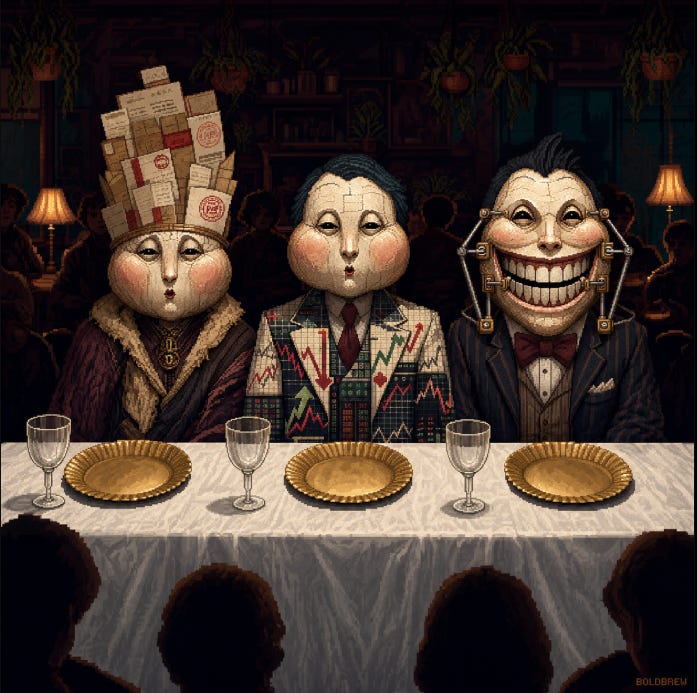
A fourth performer approached with a loaf of bread. The masked diners seized it, photographed themselves holding it, sold slices to one another, and left her the crumbs. The audience laughed. Then she removed her apron and faced us.
“I work at the dining hall that feeds four thousand students,” she began. “I skip lunch three days a week.”
The laugh folded in on itself.
Another student entered carrying a prescription bottle the size of a lantern. The diners shook pills onto their gold plates, counted them, raised the price, counted again. He watched from the end of the table.
“My mother cuts hers in half,” he told us. “Her body gets half an answer because the full answer costs too much.”
The snare began under him. One soft strike. Then another.
Lena walked into the light holding a cardboard pitchfork. “They keep asking why we’re angry.”
Around the café, the other performers rose among the townspeople.
“Because rent ate the paycheck.”
“Because the paycheck ate the body.”
“Because the body became a bill.”
The masked diners rang little bells for more. Henry’s stale rolls flew onto the table. They tore them apart, crammed their pockets, stuffed crumbs into their masks, and kept ringing.
Tony’s hand found Henry’s near the kitchen door. Greta had stopped examining the room and begun watching Lena. Marjorie pressed both palms around her cup as though she could keep something human warm inside it.
The banner dropped from the ceiling beam.
Nobody cheered. The words were too large for that. They hung above us with all the manners of a brick through a bank window.
Lena raised her pitchfork.
“They hear a threat because appetite is the only language they’ve taught us. Eat or be eaten. Own or be owned.”
The masked performers froze.
“We aren’t hungry for their bodies,” she continued. “We’re hungry for the houses they keep empty. The medicine they lock behind numbers. The hours they buy from us and sell back as freedom. We’re hungry for every decent possibility scraped from the public plate and served upstairs.”
One by one, the performers removed their masks. Underneath were faces streaked with red and gold paint. Young faces. Exhausted faces. Familiar ones.
They planted the pitchforks around the banquet table. The amber torches rose behind them, silk snapping in the small electric wind.
“The feast is over,” Lena told the diners.
The three figures looked down at their swollen pockets. For the first time, they seemed afraid.
Then Marjorie stood.
I don’t think it had been rehearsed. That was the moment the performance escaped its makers.
She carried her untouched scone to the table, broke it in half, gave one piece to the dining-hall worker, and held the other toward the masked king.
Townspeople came forward carrying cups, napkins, coins, bus passes, grocery lists, inhalers, photographs, and keys. They covered the banquet cloth with the small evidence of ordinary survival. Ollie found a brighter rhythm. Tony pulled the banner lower until everyone could see the stitching. Jasmine turned the lamps toward the crowd.
For several minutes, there was no audience.
There was only the table.
Ivy rang her brass bell once from the doorway. The sound passed through the café, clean and silver. Every cardboard pitchfork tilted toward the ceiling. Every silk flame trembled.
Outside, Brewtonia kept its streetlights on and its windows shut against the night. Inside, Henry brought out the last cardamom knots, cut each one into pieces, and set them among the keys, pills, and grocery lists.
Nobody rang a bell for more.
“That was the moment the performance escaped its makers.” What a brilliant line. We need more Marjories in the world.
An interesting performance 🙏